

Why I Tried Acupuncture for My Migraines
I’ve suffered from intense, debilitating migraines since my early 20s. They’ve been strong enough to make me call off of work, crawl into my bed and shut out the world. Migraines can have lots of triggers and originate from different muscles but my migraines originate from my trapezius muscles, that thick band running from my shoulders up to the neck and spread into the right side of my head.
After hearing so many people rave about acupuncture, I decided to give it a try! I booked an appointment and luckily that morning I started feeling a migraine coming on so it was perfect timing. I went in thinking it would be gentle and meditative, maybe even nap-worthy. Spoiler alert: it was not.
A Quick History Of Acupuncture
Acupuncture dates back over 2,500 years to ancient China. Practitioners believed the body’s energy, or qi, flows through channels called meridians, and inserting fine needles at specific points restores harmony and circulation.
Modern science has evolved this understanding. Research shows acupuncture:
- Stimulates the release of endorphins, the body’s natural painkillers.
- Activates the parasympathetic nervous system, promoting relaxation and reducing stress hormones.
- Improves blood flow and reduces inflammation in targeted tissues.
A 2017 study published in JAMA Internal Medicine found that true acupuncture (as opposed to sham or placebo) significantly reduced the frequency and intensity of migraines over 16 weeks.
The Session
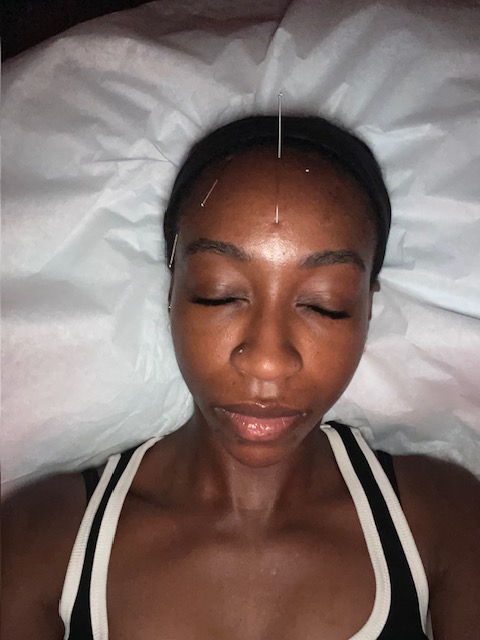
I explained to my acupuncturist that my migraines tend to start on the right side and seem connected to my shoulder and neck tension. He quickly pointed out how stiff my neck was and how my shoulders were moderately hunched up, a classic tension posture.
Then the needling began.
He inserted needles into my neck, trapezius, forehead, and upper back. I expected acupuncture to be very gentle as most people I’ve heard from describes the experience as relaxing. The first puncture into my skin was barely noticeable, but to my surprise, he would the pinch the tissue and push the needle deeper in my skin. Each time he did, I felt what I can only describe as zingy electrical zaps radiating in areas like my arm or in the general area of insertion. When he pushed certain points, there was a distinct shocking pulse, almost like the muscle was twitching in response.
It wasn’t relaxing at all, I actually found myself tensing up more!
Then came the heated red lamp, which stayed on the entire time. He left the needles in for about 20 minutes per area before removing them. When I stood up afterwards, my neck and upper back felt stiff and sore; probably a 7 out of 10 on the soreness scale. But I will say that sensation of a looming migraine I felt coming on that morning was completely gone. I had new pain to focus on!
What Those Zaps and Soreness Really Mean
After some post-session research, I realized that what I experienced was a mix of traditional acupuncture and trigger-point (dry-needling) therapy.
- Traditional acupuncture is typically gentler. Needles are inserted to stimulate energy flow (qi) and balance the body’s systems, usually causing a dull ache or heavy feeling called “De Qi.”
- Trigger-point needling, on the other hand, goes deeper into tight muscle bands, what we often call “knots.” It intentionally elicits a twitch response or radiating zap sensation to release the muscle tension and reset nerve feedback.
The “electric zaps” down my arm and the post-session soreness meant the needles had likely hit nerve-rich trigger points in my neck and trapezius. According to studies, these areas are often directly linked to migraine onset through nerve compression and referred pain pathways.
“That zing you feel isn’t random—it’s your nervous system responding to deep muscle activation.”
The Role Of The Heated Lamp
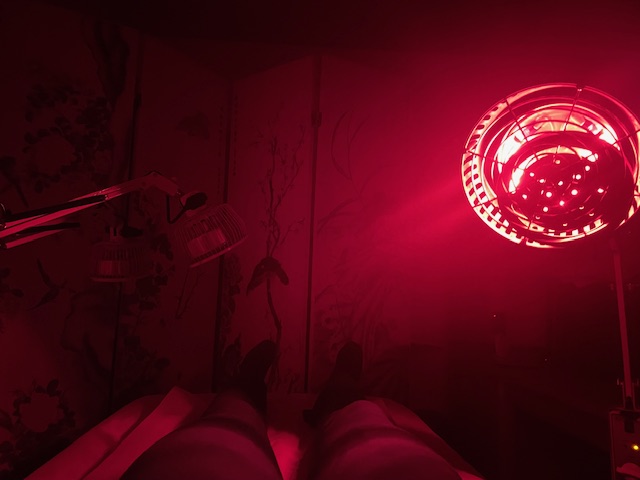
There’s intention behind the red heat lamp as well. It’s called TDP therapy, and it’s used to improve blood flow, relax tense muscle fibers, and enhance the effects of acupuncture. The warmth helps the body release endorphins while preventing the muscles from tightening around the needles.
It felt soothing at times, but combined with deep needling, it definitely amplified the after-session soreness.
How Acupuncture Helps With Migraines
Migraines aren’t just really bad headaches. They’re a complex neurological and vascular process involving trigeminal nerve sensitivity, muscle tension, and overactive pain pathways in the brain.
Acupuncture may help by:
- Calming overactive nerves through the release of serotonin and endorphins.
- Improving circulation to the neck, head, and face.
- Reducing muscular tension in the trapezius and suboccipital muscles (common migraine triggers).
- Modulating brain pain centers such as the thalamus and hypothalamus, which are overactive during migraine attacks.
In one systematic review, acupuncture outperformed conventional medication in reducing the duration and frequency of migraine attacks.
The Aftermath
That night, my muscles felt tight and tender, like I’d done an upper-body workout I didn’t sign up for. But by the second day, the soreness began to fade. By the third day (with the exception of some lingering back pain) I noticed my neck felt lighter, my range of motion had improved, and my usual tension headache didn’t flare up that day which was shocking. Usually when I get migraines, typically the only thing that stops it is taking medication like Excedrin.
I can’t say one session changed everything—but I’m excited to see whether there will be any change in the frequency of migraines with continuous use of acupuncture.
Was it painful? Yes. Effective? Possibly. Immediate results I’m impressed with. If acupuncture can reduce my migraines permanently then it’s absolutely worth it. But it’s worth getting an understanding of what technique the practitioner will be using so you’re prepared.
Takeaways if You’re Considering Acupuncture for Migraines
- Ask your practitioner what technique they’re using (traditional vs. trigger-point).
- Expect soreness if you’re getting deep muscle work especially in the traps, upper back and neck.
- Use heat or gentle stretching after your session to ease stiffness.
- Communicate your pain tolerance. Acupuncture shouldn’t feel like you’re being tortured but everyone’s pain tolerance is different
- Track your migraine frequency over the next few weeks. Although acupuncture takes sessions to see lasting results, I’m curious if this reset will make any noticeable difference on how quickly my migraine returns
My Thoughts
My first acupuncture session wasn’t the calm, candle-lit experience I imagined but I’m hoping it’s exactly what my muscles needed. If your migraines come from neck and shoulder tension, deeper acupuncture or trigger-point needling could be worth exploring.
Sometimes healing isn’t always peaceful. But the lasting results can be.
References
https://jamanetwork.com/journals/jamainternalmedicine/fullarticle/2603492
https://www.frontiersin.org/journals/neurology/articles/10.3389/fneur.2025.1601554/full
https://pmc.ncbi.nlm.nih.gov/articles/PMC11786601




 Newsletter


You must be logged in to post a comment.